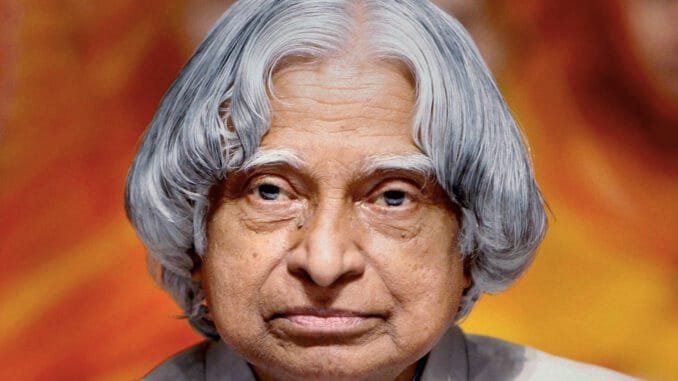
APJ Abdul Kalam biography explores India’s Missile Man and 11th President. Discover his achievements, famous books, awards, and inspiring life journey.
Who is APJ Abdul Kalam?
APJ Abdul Kalam biography chronicles the extraordinary life of India’s most beloved scientist and statesman. Born Avul Pakir Jainulabdeen Abdul Kalam on 15 October 1931 in Rameswaram, Tamil Nadu, he rose from humble beginnings to become the 11th President of India. Known as the “Missile Man of India” and the “People’s President,” Kalam passed away on 27 July 2015 at the age of 83.
Kalam’s journey represents one of the most inspiring stories in modern Indian history. From selling newspapers as a young boy to leading India’s missile and nuclear programmes, his life exemplifies perseverance and dedication. His contributions to aerospace engineering transformed India into a recognised nuclear power and space-faring nation.
Beyond his scientific achievements, Kalam touched millions of lives through his interactions with students. His simple lifestyle, humility, and commitment to national development made him a role model for generations. He authored several bestselling books that continue to inspire readers worldwide.
Kalam served as President from 2002 to 2007, becoming the first scientist and bachelor to hold India’s highest constitutional office. His tenure was marked by accessibility to common citizens and passionate advocacy for youth empowerment.
Quick Facts Table
| Attribute | Details |
|---|---|
| Full Name | Avul Pakir Jainulabdeen Abdul Kalam |
| Date of Birth | 15 October 1931 |
| Date of Death | 27 July 2015 (aged 83) |
| Place of Birth | Rameswaram, Tamil Nadu, India |
| Religion | Islam (Sunni Muslim) |
| Nationality | Indian |
| Father | Jainulabdeen Marakayar (Boat owner, Imam) |
| Mother | Ashiamma (Housewife) |
| Siblings | Four brothers and one sister |
| Marital Status | Never married |
| Education | Madras Institute of Technology (Aerospace Engineering) |
| Profession | Aerospace Scientist, Statesman, Author |
| Known For | Missile Man of India, People’s President |
| Presidential Term | 2002–2007 (11th President of India) |
| Highest Award | Bharat Ratna (1997) |
Early Life and Background
APJ Abdul Kalam was born into a humble Tamil Muslim family in the pilgrimage town of Rameswaram on Pamban Island. His father, Jainulabdeen Marakayar, was a boat owner who ferried Hindu pilgrims between Rameswaram and Dhanushkodi. He also served as the imam of the local mosque. His mother, Ashiamma, was a devoted housewife who nurtured her children with strong moral values.
Kalam was the youngest of five siblings, with four elder brothers and one sister. Although his ancestors had been wealthy traders, the family faced financial difficulties by his birth. The opening of the Pamban Bridge in 1914 had adversely affected their ferry business.
To contribute to the family’s modest income, young Kalam sold newspapers early in the morning before attending school. This experience taught him the value of hard work from an early age. His father, though not formally educated, imparted wisdom and the importance of interfaith harmony.
Educational Background
Kalam received his early education at Schwartz Higher Secondary School in Ramanathapuram. Though he achieved average grades, his teachers recognised him as a hardworking student with an exceptional desire to learn. He spent countless hours studying mathematics, which became his favourite subject.
After completing his schooling, Kalam graduated with a degree in Physics from St. Joseph’s College, Tiruchirappalli, in 1954. His fascination with flight led him to pursue aerospace engineering at the Madras Institute of Technology in Chennai. During his time at MIT, a challenging project deadline tested his resolve, and Kalam met it, demonstrating determination that would define his career.
He had dreamed of becoming a fighter pilot but missed the opportunity by a narrow margin, ranking ninth while only eight positions were available. This setback redirected his path towards aerospace research.
Career Journey
Kalam’s professional career began in 1958 when he joined the Defence Research and Development Organisation (DRDO) as a scientist. He initially worked on designing a small hovercraft for the Indian Army. In 1963, he worked under the legendary scientist Vikram Sarabhai as part of the Indian National Committee for Space Research.
In 1969, Kalam transferred to the Indian Space Research Organisation (ISRO), where he served as Project Director for India’s first indigenous Satellite Launch Vehicle (SLV-III). Under his leadership, the SLV-III successfully deployed the Rohini satellite into near-Earth orbit in July 1980, making India an exclusive member of the international space club.
Returning to DRDO in the 1980s, Kalam became Chief Executive of the Integrated Guided Missile Development Programme. He led the development of iconic missiles including Agni, Prithvi, Akash, Trishul, and Nag. These achievements earned him the title “Missile Man of India.” He played a pivotal role in the Pokhran-II nuclear tests in 1998, establishing India as a nuclear weapons state.
Career Timeline
| Year | Milestone | Significance |
|---|---|---|
| 1958 | Joined DRDO | Started career as scientist |
| 1969 | Transferred to ISRO | Became SLV-III Project Director |
| 1980 | Rohini satellite launch | India joined space club |
| 1992 | Chief Scientific Adviser | Advised Prime Minister |
| 1997 | Received Bharat Ratna | India’s highest civilian honour |
| 1998 | Pokhran-II nuclear tests | India became nuclear power |
| 2002 | Elected President | Became 11th President of India |
| 2007 | Completed Presidential term | Returned to teaching |
Personal Life
APJ Abdul Kalam remained a lifelong bachelor, choosing to dedicate his life entirely to science, education, and national service. He never married and had no children. His decision allowed him to focus completely on his work and passion for inspiring young minds.
Despite his extraordinary achievements, Kalam lived a remarkably simple life. He possessed few personal belongings and led an austere existence even as President. He was known for his vegetarian diet, his love for playing the veena, and his habit of waking up early for morning prayers.
Kalam maintained close bonds with his siblings throughout his life, regularly sending them financial support. After his presidency, he owned no property, car, or significant assets. His estate consisted mainly of his books, a veena, and a few personal items.
Major Achievements
Kalam’s contributions to Indian science and technology remain unparalleled. As Project Director, he successfully led the SLV-III programme that launched India’s first satellite. His leadership of the missile programme resulted in five missile systems that transformed India’s defence capabilities.
He received India’s three highest civilian honours: the Padma Bhushan (1981), Padma Vibhushan (1990), and Bharat Ratna (1997). He became only the third President to receive the Bharat Ratna before assuming office. International recognition included the Hoover Medal (2009) and the Von Braun Award (2013).
His vision document “Technology Vision 2020” outlined a roadmap for transforming India into a developed nation. As President, he advocated for youth empowerment and technological innovation, visiting schools across India and encouraging students to dream big.
Books and Literary Works
Kalam authored numerous inspirational books that became bestsellers. His autobiography “Wings of Fire” (1999), co-authored with Arun Tiwari, narrates his journey from Rameswaram to becoming a renowned scientist. The book has inspired millions and been translated into multiple languages.
“India 2020: A Vision for the New Millennium” (1998) presented his ambitious vision for India’s development. “Ignited Minds: Unleashing the Power within India” (2002) called upon young Indians to work towards national greatness. Other notable works include “The Luminous Sparks,” “Guiding Souls,” “Turning Points,” and “Transcendence.”
His books consistently emphasised perseverance, self-belief, scientific temper, and patriotism. They continue to be prescribed reading in schools across India.
Final Thoughts
APJ Abdul Kalam’s life stands as a testament to the transformative power of education, hard work, and dedication to one’s nation. From a newspaper-selling boy in a small temple town to the President of the world’s largest democracy, his journey embodies the essence of the Indian dream.
His death on 27 July 2015, while delivering a lecture to students at IIM Shillong, was symbolic of his life’s purpose. He departed doing what he loved most—inspiring young minds. His legacy lives on through numerous institutions named in his honour, including Abdul Kalam Island and the Dr. A.P.J. Abdul Kalam Memorial in Rameswaram.
Kalam’s teachings on dreaming big and serving the nation continue to guide millions. His life reminds us that greatness is determined not by birth but by determination and integrity.
FAQs About APJ Abdul Kalam
When was APJ Abdul Kalam born and when did he die?
APJ Abdul Kalam was born on 15 October 1931 in Rameswaram, Tamil Nadu. He passed away on 27 July 2015 at IIM Shillong at the age of 83.
Why is APJ Abdul Kalam called the Missile Man of India?
Kalam earned the title for his leadership in developing India’s ballistic missile programme, including the Agni, Prithvi, Akash, Trishul, and Nag missiles.
Was APJ Abdul Kalam married?
No, APJ Abdul Kalam never married. He remained a lifelong bachelor, dedicating his life to science, education, and national service.
Which awards did APJ Abdul Kalam receive?
Kalam received India’s highest civilian honours: Padma Bhushan (1981), Padma Vibhushan (1990), and Bharat Ratna (1997).
What are APJ Abdul Kalam’s famous books?
His notable books include “Wings of Fire,” “India 2020,” “Ignited Minds,” “The Luminous Sparks,” and “Transcendence.”
Which President was APJ Abdul Kalam?
APJ Abdul Kalam served as the 11th President of India from 2002 to 2007.
Leave a Reply